

The Secret Blend Behind Modern Surveillance
The Secret Blend Behind Modern Surveillance https://urbanspy.com/wp-content/uploads/2026/06/Q4_2025_Chronicle-1-939x1024.webp 939 1024 Urban Spy Urban Spy https://secure.gravatar.com/avatar/13a543fc12c067a9f477941b85c18302cd30f05b34c2c3b2f25b72ea0e649d9c?s=96&d=mm&r=g- Urban Spy
- no comments
What separates good surveillance from excellent is rarely luck. It’s about coordination – the right people in the right places, with the right tools and instincts. Over the years, Urban Spy has learned that one of the most underrated strengths in fieldwork comes from the balance of a team built not just on skill, but on leveraging the value of collaboration and embracing the differences between male and female mindsets and life experiences.
We’ve all experienced surveillance situations where a lone investigator doesn’t blend. For example, a man parked near a playground or park bench draws suspicion in minutes; a woman sitting alone outside a construction zone or storage lot raises her own set of questions. However, a man and a woman together, appearing to chat, read, share a drink, or walk a dog, can exist unnoticed in nearly any environment. The same goes for street setups. In residential areas blanketed with Ring and Nest cameras, a solo vehicle idling can quickly stand out. Alternatively, a couple sitting in a car integrates well and appears to be having a conversation or looking for directions on a neighborhood street or cul-de-sac.
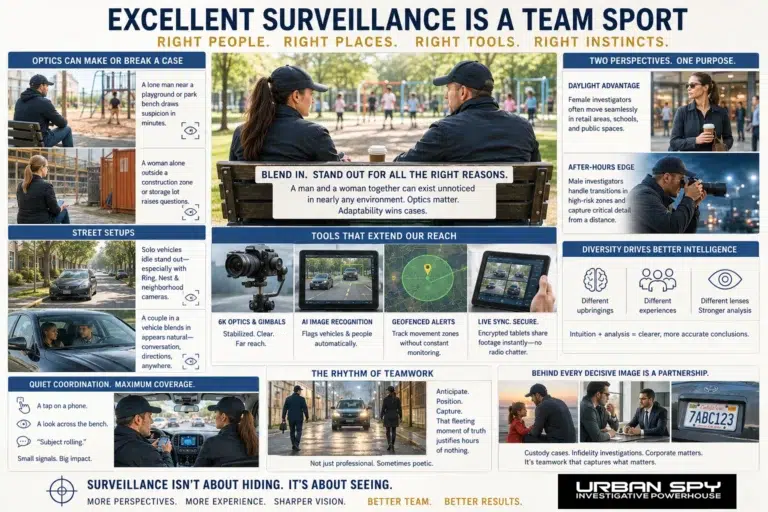
These subtle optics can, at times, make or break a case. Used correctly, gender balance and situational adaptability can expand and amplify what we observe, as well as how convincingly we can integrate it. A female investigator might comfortably conduct daylight follow-throughs in retail areas or schools, while her male partner handles after-hours transitions in rougher zones or conducts long-lens captures from a distance: both perspectives, both instincts, one clean chain of evidence in each scenario.
That said, diversity extends beyond who’s in the vehicle. Investigators with diverse upbringings, parental role models, temperaments, and cognitive styles interpret behavior differently, which strengthens our analysis. One may read body language intuitively; another may notice digital breadcrumbs or license plate patterns. The combination produces fuller, more balanced conclusions and a more accurate picture of events.
Our tools mirror that variety. The modern field kit isn’t just a sedan and DSLR anymore; it’s an integrated, connected, miniature command center. Vehicles equipped with High-resolution 6K optics stabilized on gimbals with zoom capabilities, AI-assisted image recognition that flags vehicles or people automatically, and geofenced alerts that track movement zones without constant eyes on screen. Even data sync between partners is now seamless: encrypted tablets share live footage across secure networks, allowing for instant confirmation without the need for radio chatter. The technology gives us reach, but it’s the team that gives it context.
Still, the core of effective surveillance remains human, integrating experience and communication. Quiet coordination, the kind forged through long hours and the development of subtle signals, prevents missed angles or duplicated effort. A tap on a phone, a look across a park bench, and the quick phrase “subject rolling” are all driving the most seamless and immediate coverage possible.
When the rhythm clicks, it feels less like work and more like a choreographed dance. Two investigators moving in sync, anticipating instead of reacting. When the capture occurs, that fleeting moment of truth emerges, justifying hours of nothing. At times, it’s not just professional, it’s almost poetic.
We’ve all shared those moments: the still frame or video that shifts a custody or infidelity case, the discreet sequence that changes a corporate investigation’s outcome, or the detail that, at times, only teamwork can catch. Behind every decisive image is a partnership that worked, between people, not just pixels.
As our field evolves, so should our teams. The more diverse the experience and perspectives we bring, whether male or female, seasoned or new, intuitive or analytical, the sharper our vision becomes. Surveillance isn’t about hiding; it’s about seeing. And in today’s landscape of cameras, sensors, and digital trails, seeing clearly sometimes takes more than one person’s gender and individual lens.
The Chronicle 2025 – Volume 4 KWB ARTICLE NOV 24, 2025

- Posted In:
- Investigative Articles & Resources
